|
|
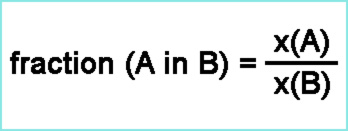
Knowledge database: Stoichiometry: Fractions Fractions are commonly used in stoichiometry and can be defined as the quotient of a phyical quantity of one component (A in the formula) by the value of (that same) physical quantity of the whole mixture.
The mentioned definition can simply be represented by the generic formula shown above. Here we will mention the three most basic formulas for the calculation of fractions, depending on the physical quantity which they deal with: 1) The mass fraction: w(A in B) = m(A) / m(B) 2) The volume fraction: φ(A in B) = V(A) / V(B) 3) The molar fraction: x(A in B) = n(A) / n(B)
|
Basics |